



How to Cut Safety Tiles
- Thomas
- 20. February 2025
Safety tiles are a critical component of playgrounds, gyms, and calisthenics parks, helping absorb impact and reduce injury risk. Especially for fall heights above 24 inches (60 cm), the right safety surfacing is essential. During installation, it is often necessary to cut rubber safety tiles or PU-bonded rubber surfacing panels to ensure a precise fit.
Clean, accurate cuts are especially important along edges and perimeter areas to maintain a stable, professional-looking installation. Because rubber surfacing is flexible yet durable, cutting it requires the right technique—and the right tools.
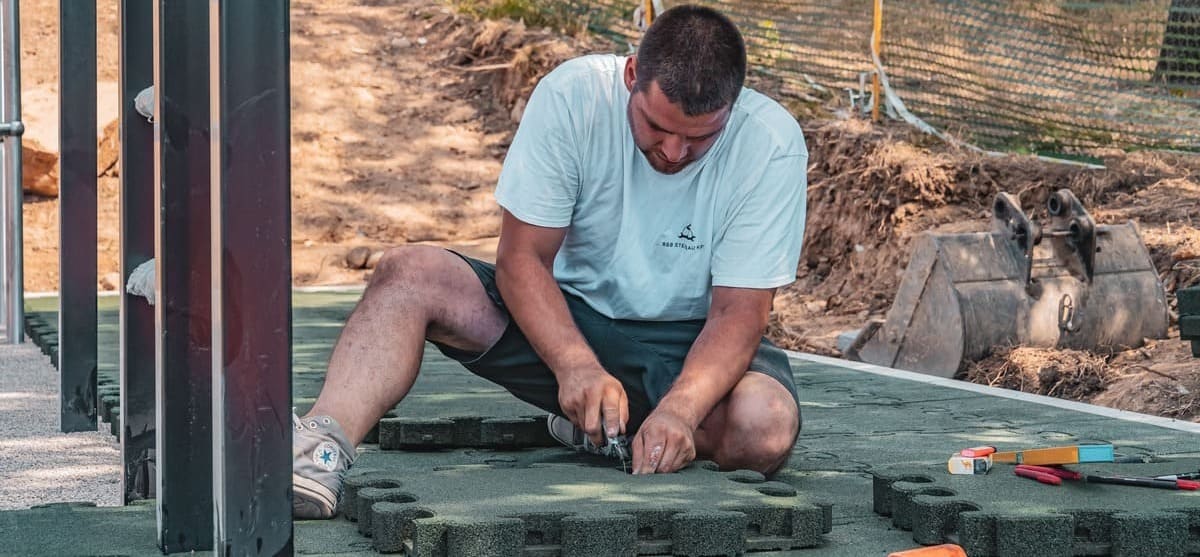
Table of Contents
Tools & Materials for Cutting Rubber Granulate
Recommended Tools
- Utility knife (box cutter) – best for thin tiles or minor adjustments. A sharp blade is crucial for clean, efficient cuts.
- Jigsaw – ideal for controlled, precise cuts along straight or curved lines.
- Reciprocating saw (Sawzall) – useful for thicker tiles or rough cuts.
Additional Materials
- Chalk line or straightedge for accurate marking
- Work gloves and safety glasses for protection
Special Recommendation
If you are cutting the FX Safety Tile by Gum-tech®, we recommend a soft jigsaw blade, such as the Bosch T 313 AW. This blade provides clean, precise cuts and minimizes edge fraying.
Tools NOT Recommended for Cutting Safety Tiles
Some tools can damage the material or create uneven cuts:
❌ Tile cutters – Rubber cannot be snapped or scored like ceramic tile.
❌ Circular saws or table saws – Designed for wood or rigid materials; can tear soft rubber.
❌ Angle grinder (cut-off wheel) – High heat and friction may melt the rubber and leave burned edges.
Preparing the Tile for Cutting
Before you cut, prepare your work area:
- Measure the required tile size accurately using a tape measure.
- Mark the cut line with a chalk line or straightedge.
- Secure the tile on a stable surface (workbench or sawhorses) to prevent slipping.
A stable setup ensures clean, accurate cuts and reduces the risk of injury.
Step-by-Step Cutting Guide (Using a Soft Jigsaw Blade)
This method works well for rubber tiles up to approx. 20 mm thick.
Secure the Tile
Place the tile on a stable surface with slight overhang. Hold it in place using clamps or weights to prevent movement.
Mark the Cut Clearly
Use a straightedge or chalk line to draw your cut. Enhance visibility with chalk or a white marker if needed.
Begin Cutting at Low Speed
Position the soft jigsaw blade (e.g., Bosch T 313 AW) at the edge of your cut line. Start with low speed to avoid tearing or grabbing.
Guide the Saw with Steady Pressure
Move the jigsaw smoothly along the line. Avoid pushing too hard—the blade will naturally move through the rubber. TIP: If the rubber flexes, gently pull down on the cut edge to stabilize the material.
Finish & Smooth the Edges
After cutting, trim any uneven edges using:
• a utility knife
• a rasp/file
• fine sandpaper (optional for a rounded finish)
Choosing the Right Jigsaw Blade
- Tooth pattern & material: Fine or coarse; blades available in HSS, HCS, or bi-metal
- Flexibility: Soft, flexible blades like the Bosch T 313 AW are ideal for rubber surfacing, foam, and playground tiles
Tips for Cutouts & Curved Cuts
Curved or Circular Cutouts
Use a jigsaw with a narrow blade.
Move slowly and maintain steady pressure to avoid tearing the surface.
Straight Cuts
- For thin tiles: use a utility knife, scoring the line several times
- For thicker tiles: use a jigsaw or reciprocating saw with a soft blade
Common Mistakes & How to Avoid Them
❌ Using the wrong tool
Use a saw for thicker safety tiles—don’t force a utility knife.
❌ Inaccurate measurements
Measure twice, cut once. This prevents misaligned edges.
❌ Applying too much pressure
Let the tool do the work. Excess pressure causes jagged edges.
FAQ
Yes.
A jigsaw with a soft, flexible blade (e.g., Bosch T 313 AW) cuts rubber tiles cleanly. Use low speed and steady pressure to avoid fraying.
Technically yes—but not recommended.
Angle grinders generate high heat and friction, which can melt rubber and leave rough edges. If absolutely necessary, use a fine-tooth disc for soft materials.
For clean, professional results, use:
✔ a jigsaw
✔ a reciprocating saw
✔ a bandsaw
Depending on thickness:
- Reciprocating saw: best all-around option
- Bandsaw: excellent for consistently straight, smooth edges
- Angle grinder: only for very thick/hard mats, with proper disc
- Jigsaw: works if under ~20 mm and using a soft blade
Auch interessant