Building a basketball court
- Thomas
- 4. March 2025
Basketball is one of the most popular sports worldwide, played by millions—from professional athletes to recreational players. The sport originated in 1891 when Dr. James Naismith created an indoor game for the winter months. Today, basketball is deeply rooted in North America but continues to grow across Europe and around the globe.
Understanding official basketball court dimensions is essential for fair play and consistent performance—whether indoors or on an outdoor public court. Across NBA, FIBA, NCAA, and recreational formats, the exact measurements and markings shape gameplay, strategy, and rule compliance.
This guide breaks down the official dimensions of a basketball court, explains key markings, outlines construction considerations, and explores the best flooring options—especially for outdoor courts using high-performance rubber sports flooring.

Table of Contents
Basketball Court Overview
A basketball court is a rectangular playing surface standardized by the Fédération Internationale de Basketball (FIBA) and other major leagues. Compared to many sports surfaces, a basketball court is relatively large at 420 square meters (FIBA standard) and contains several critical lines and markings that govern game flow and player movement.
Official Basketball Court Dimensions
Court size varies slightly depending on league standards. Here are the most relevant measurements:
FIBA (International Standard)
- Length: 28 m
- Width: 15 m
NBA (Professional League, USA)
- Length: 28.65 m (94 ft)
- Width: 15.24 m (50 ft)
NCAA (U.S. College Basketball)
- Length: 28.65 m (94 ft)
- Width: 15.24 m (50 ft)
Outdoor Basketball Courts
Outdoor courts often differ in size and may be smaller than official indoor courts.
Common recreational dimensions:
- 26 × 14 m
- 24 × 13 m
Basket Height (All Leagues)
- 3.05 m (10 ft)
Key Court Markings
Center Line & Center Circle
- Divides the court into two halves
- Center circle diameter: 3.6 m (FIBA) or 3.66 m (NBA)
Three-Point Line
Distances vary by league:
- FIBA: 6.75 m from the basket center
- NBA: 7.24 m (23 ft 9 in)
- NCAA: 6.75 m
Free-Throw Line & Key
- Free-throw line: 4.6 m from the basket
- Key (painted area):
- FIBA: 4.9 m wide
- NBA: 4.88 m wide (16 ft)
Planning & Building a Basketball Court
Constructing a basketball court requires careful planning to meet safety and performance standards.
Court Size
A full court should measure: • 28 m × 15 m (FIBA)
Surface Material
Lines must be clearly visible and comply with FIBA or other league standards.
Court Markings
Essential components include:
• Basketball hoops
• Nets
• Stanchions
• Referee equipment
Equipment
Das Feld sollte mit den notwendigen Ausstattungen wie Körben, Netzen und Schiedsrichterstühlen ausgestattet sein.
Player Safety
Safety features should include:
• Adequate run-off areas
• Shock-absorbing flooring
(required for youth and community courts)
• Regular maintenance and inspections
Rubber Sports Flooring (Outdoor)
A highly preferred option for public parks, schools, and community courts because it is:
- Shock-absorbent
- Slip-resistant
- Weatherproof
- Safer for falls and joint impact
- Durable and low-maintenance
Rubber Sports Flooring by Gum-tech®
Gum-tech® has manufactured recycled rubber surfacing since 1995, offering long-lasting and environmentally friendly solutions for playgrounds, sports facilities, and outdoor fitness spaces.
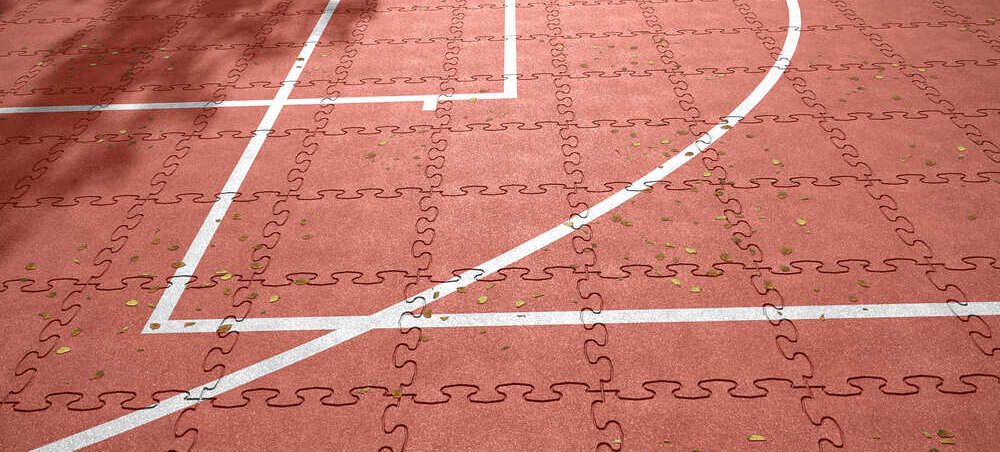
Puzzle Mat 3D® Sports Tiles
Ideal for basketball courts and multi-sport surfaces.
Key features:
- Tested ball rebound according to DIN EN 12235 (2013-12)
- Shock-absorbing and joint-friendly surface
- Highly weather-resistant
- Excellent slip resistance
- Sustainable manufacturing using recycled rubber
- Ideal for long-lasting outdoor sports courts
FAQ
- 28.65 m × 15.24 m (94 ft × 50 ft)
The key (also called the paint) is the rectangular area under the basket.
- NBA width: 4.88 m
- FIBA width: 3.6 m (newer trapezoid removed)
It regulates player movement, especially regarding defensive and offensive positioning.
Auch interessant
More articles